
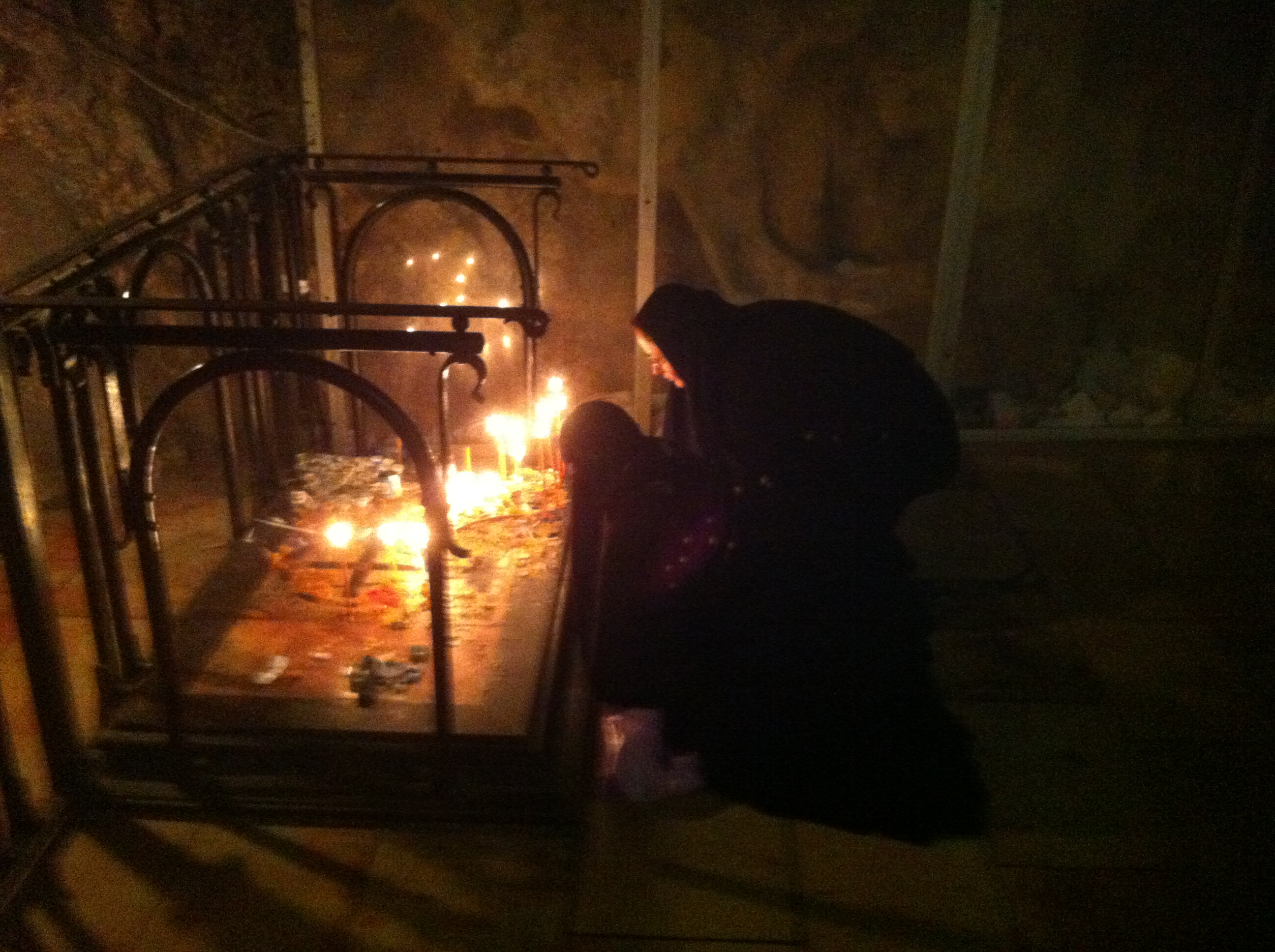
Deep inside the Church of the Holy Sepulcher, orthodox nuns light candles.
We’d been three weeks in the Holy Land – one of those weeks in Jerusalem itself – and we still hadn’t been to the Church of the Holy Sepulcher – the site of the tomb where Jesus was buried after his death on a Roman cross.
We decided to go on our last Sunday in town.
The general location is pretty accurate. At least my reference book supports the claim as “very probably” the place where Jesus was buried based on archaeological and historical data. Constantine, following the oral tradition of Jerusalemites, tore down Hadrian’s pagan temple and built a church on the site. It was finished in 335 A.D.
Since then, rooms, alcoves and chambers have been added as the site got more and more traffic from Christian pilgrims around the world. I had actually read too much of the history of the Church of the Holy Sepulcher to be awed by the place. Though I hate to admit it, I entered the church filled more with cynicism toward religion than awe of Jesus’ having something to do with it.
I’m glad I did. That way I was fairly entertained by human nature instead of monumentally disappointed by the encrusted religion. The place was dark and noisy and, on this particular Sunday afternoon, more full of orthodox costumes than any other as Orthodox Easter was just ending.
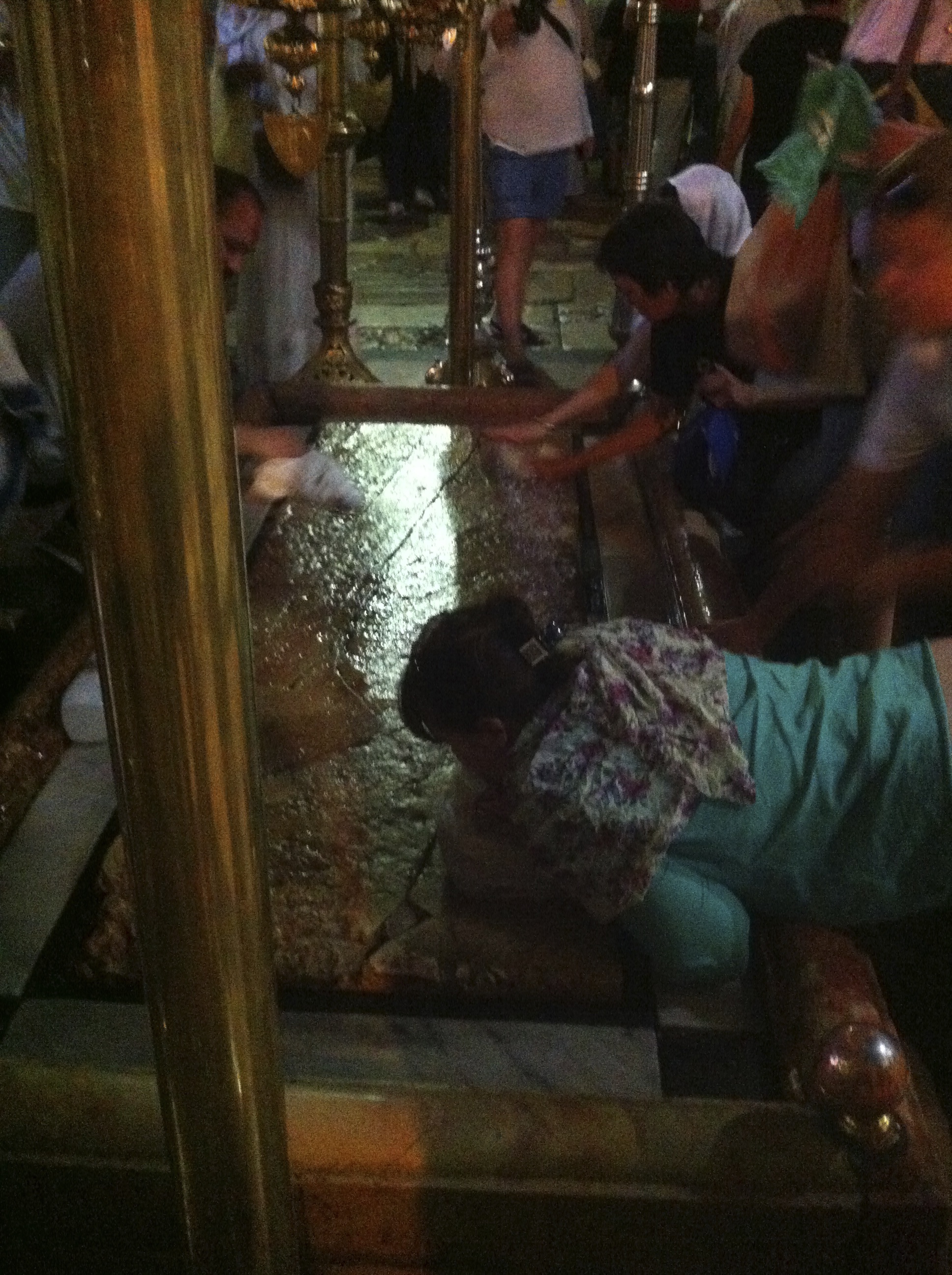
I was fascinated watching men and women pour oil (probably myrrh or
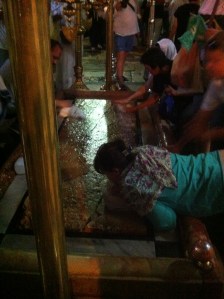
The Stone of Unction?
frankincense) on a slab of stone in the first room and then wipe it with their scarves or shirts or kneel beside the stone kissing it and laying half their body across it. They believe Jesus’ body was laid upon this Stone of Unction while his disciples prepared him for burial. That particular stone of unction was circa 1800s, according to my archaeology text. I wonder if the people sprawling on top of it knew that.
Some of these faithful had probably gotten to see the Descent of the Holy Fire the night before. I know two of my dorm roommates were there. One was from Georgia (the country, not the state) and the other from Eritrea.
The church of the Holy Sepulcher is standing room only for this event in which all lights are extinguished, the tomb is sealed and everybody waits in darkness until just before midnight when a priest enters the tomb.
As one author recounted: “After a long interval of spine-tingling anticipation, a spark seemed to descend from above, a flame flickered, brightness flared and the patriarch emerged with a mysteriously lit lamp. This sacred flame was distributed from candle to candle through the crowd to screams of joy and acts of wild abandon.”
This ritual was first mentioned in 870 A.D. That it’s considered a divine confirmation of Jesus’ resurrection doesn’t do the faith any favors, especially since over the years it’s been exposed as a little trick with wire and oil and a monk somewhere in the rafters.
We saw a video being sold Sunday afternoon of the packed church on the previous night. Pilgrims passed the “holy fire” from candle to candle. There were lots of ecstatic people and lots of noise with a sprinkling of ululations. I assume that would be the Eritreans, not the Georgians.
After seeing the video I can imagine how riots and fires have broken out over the centuries. Not sure what the accumulative death toll from the Descent of the Holy Fire is over the last 1,200 years, but I bet it’s considerable, especially since fire exits seemed to be scarce and bad blood plentiful between Christian sects. At least once the place has burned down because the Holy Fire got out of hand, and at least once the ceremony ended in a blood bath because rivals brought their weapons.
The Church of the Holy Sepulcher has had its share of orgies as well. During the Middle Ages, it was considered an extra blessing to conceive at the Church of the Holy Sepulcher. Pilgrims used to be able to stay the night in the church. You can imagine the rest.
And as if riots and orgies weren’t enough, Latin Catholics, Greek Orthodox, Armenians, Syrians, Copts and Ethiopians have fought so much over control of the Church of the Holy Sepulcher that in 1192 the Muslim Caliph Saladin entrusted the keys of the place to a Muslim family. The Nuseibeh family still opens and closes the place to this day.
In fact, we think we saw some of the Nuseibehs overseeing the line to enter the tomb itself. The evening we visited a fight nearly broke out because folks who had been waiting hours in line were being cut in front of by special friends of a particular orthodox priest. It looked like the Muslims were there to keep the peace.
In a place like the Church of the Holy Sepulcher, so encrusted with religion, it’s hard to get to the substance of our faith anymore. Nonetheless, people come here to try. They want to see and feel the place where the fully God and fully man conquered death, but the tomb is empty. That’s the point.
It’s just as well Jesus isn’t there. He might not survive the next fight that breaks out among his followers.






 1sojourneronearth